
MENU

Minimum Tax on Discretionary Trusts

By Sally Storey (Partner, Brentnalls SA)

The Government announced proposed changes to the taxation of discretionary trust in the Federal Budget in May this year.

Recently they released draft legislation for consultation before it is finalised. These laws represent a major shift in the tax landscape and have an enormous impact on how Australians structure small businesses, landholdings, investments and their estates.

The main proposal is to impose a tax of 30% on the taxable income of discretionary trusts from 1 July 2028 (i.e. the 2029 financial year).

Credit for the tax paid will be a non-refundable tax offset for the beneficiary, except where they are a corporate beneficiary.

Trusts that are affected will be called “minimum tax trusts”.

Some trusts are excluded such as:

  • Fixed trusts
  • Special disability trusts
  • Deceased estates
  • Superannuation funds
  • Testamentary trusts in existence at 12 May 2026
  • Testamentary trusts from 1 July 2028 which only allow distributions to individuals or tax-exempt entities

Also, some types of income are excluded such as:

  • Primary production income
  • The share of income distributed to a non-resident
  • The share of income distributed to vulnerable children

What is the impact of the 30% minimum tax?

A 30% tax rate may not sound particularly high, given an individual earning more than $45,000 is on a marginal tax rate of 30%. Therefore, if the beneficiaries of the trust all have income from other sources exceeding $45,000 (net of any available deduction), the minimum tax will not have any negative impact.

However, if some, or all, of the beneficiaries of the trust have income below $45,000, they will likely be worse off.
To illustrate, let’s assume a minimum tax trust distributes income to an individual adult resident beneficiary who has no other income. The table below shows the additional tax at each level of distribution (excluding Medicare Levy).

This demonstrates that a beneficiary with no other income is worse off under the new tax up to a taxable income of nearly $230,000 (the exact breakeven point being $229,320). 

How would franking credits be treated under the proposed trust tax rules?

Where a minimum tax trust receives franked dividends, the trust will be able to use the resulting franking credits to pay the 30% minimum tax. If the trust has more franking credits than needed for the tax, the excess will be refunded to the trust. No franking credit will flow through to beneficiaries.

Where a minimum tax trust distributes to another minimum tax trust, credit from the first trust can be used to pay the minimum tax for the second trust. However, if the tax of the first trust exceeds that of the second (e.g. because the second trust has a loss), the excess will not be refunded or carried forward.

What options could trustees have to avoid the new 30% minimum tax?

The Government is proposing two options for trusts to avoid the new 30% minimum tax. These are:

  • A rollover to a different structure, available between 1 July 2027 and 30 June 2030.
  • An election to only make distributions to nominated beneficiaries, available for lodgement with the 2029 tax return.

Both options come with their own complexities, pros and cons. As the law is still in draft form, we will not go into this detail but note neither option should be taken lightly. Trusts can choose either option but not both options.

They may also choose:

  • Neither option and be subject to the minimum 30% tax
  • To restructure using existing rollovers or concessions, such as the small business CGT concessions

What actions should I take now?

We are providing feedback through the consultation process and expect that there will be some changes to the draft legislation. Therefore, we suggest waiting until the law is enacted before making any decisions. Once the legislation is finalised, we will be able to advise you on your personal circumstances and the available options.

Contact us to discuss any of the above in further detail or find out how Harris Black can help you.

Burnout Is Now A Load Problem, Not Just An Hours Problem

The rate of change in business is faster than ever. New technology, shifting client expectations and constant access to information mean leaders are making more decisions, processing more inputs and adapting more frequently. For many business leaders, burnout is therefore no longer simply about working long hours, it is increasingly driven by cognitive overload.

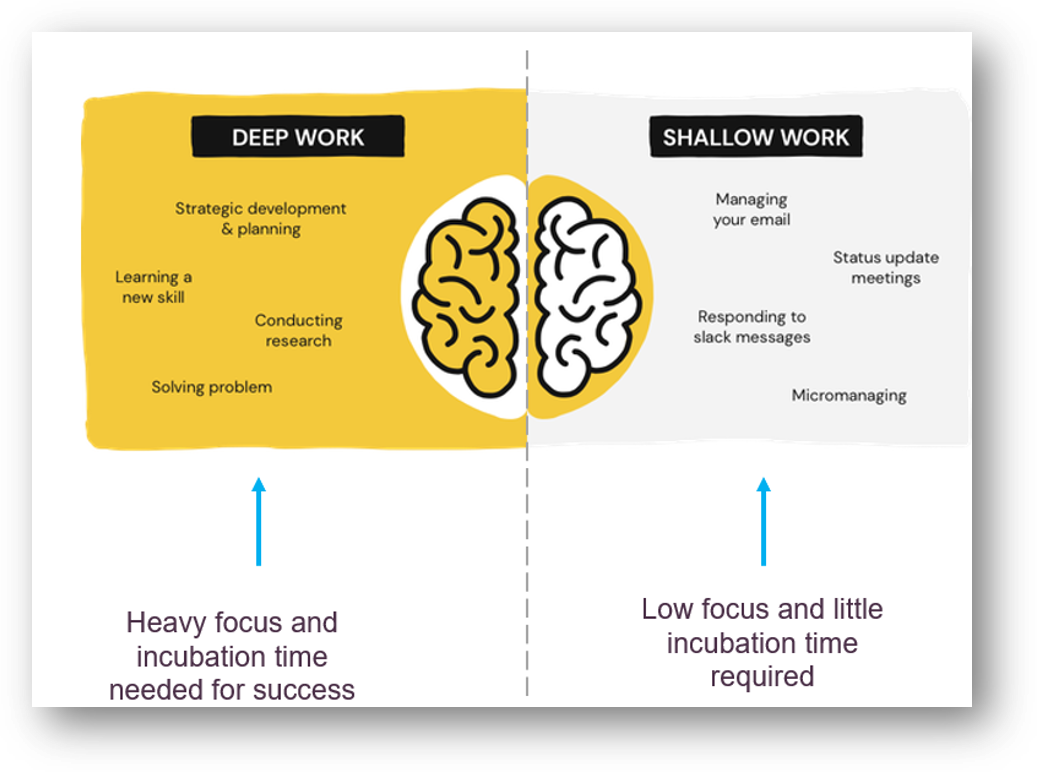
Research referenced in our recent leadership session suggests that after an interruption, it can take approximately 23 minutes to fully refocus. When this happens repeatedly throughout the day, important strategic work is easily crowded out by emails, meetings, approvals and status updates.

Newport, C. (2016). Deep Work: Rules for Focused Success in a Distracted World. Grand Central Publishing.

AI is making work faster, but is it making leadership harder?

Artificial intelligence offers significant opportunities to improve efficiency, particularly for routine tasks such as drafting, formatting, summarising and preparing updates. However, it can also increase the volume of work requiring review.

Emails become longer, short reports turn into lengthy drafts and meeting notes become detailed essays. Without clear direction and quality standards, AI may help teams produce more work without necessarily producing more value.

This presents a particular challenge for traditional business structures, where work flows upward and the leader acts as the final reviewer, approver and decision-maker. As AI accelerates the volume of analysis, communication and reporting, the leader can quickly become the bottleneck.

A different approach to leadership

The answer is not to avoid AI. It is to lead differently.

Leaders may need to become involved earlier in the process, setting a clear direction before significant work begins. This means defining the purpose, desired outcome, boundaries and expected level of detail before a team member or AI tool starts producing an answer.

Work can then be separated into two broad categories:

  • Judgement-based work, which requires human experience, context, creativity and decision-making.
  • Repeatable work, which can be completed or supported by AI within clear parameters and appropriate quality controls.

This allows routine work to move efficiently while ensuring matters requiring genuine judgement receive the right level of human attention. It can also reduce the volume of unnecessary work reaching leaders for final review.

Five practical steps for business leaders

1. Protect thinking time like a meeting

Block uninterrupted time in your calendar for strategically important work. Treat this time as seriously as a client or board meeting and avoid using it to clear emails or review routine outputs.

2. Set a quality bar, not a quantity bar

Make it clear that a concise and practical one-page plan is often more valuable than a five-page AI-generated draft. Reward clarity, judgement and usefulness rather than volume.

3. Set the direction before AI is used

Most AI problems begin with an unclear brief. Define the goal, audience, constraints and desired output before work starts. AI can accelerate progress, but it can also accelerate work in the wrong direction.

4. Treat recovery as an input to performance

Sleep, exercise, family time and clear finishing times should not be seen merely as rewards when work is complete. They help protect the mental capacity required for good decisions, strategic thinking and resilience.

5. Review where your attention goes

At the end of each week, consider what required genuine thinking and what was largely reactive noise. Identify tasks that can be delegated, simplified, automated or stopped altogether.

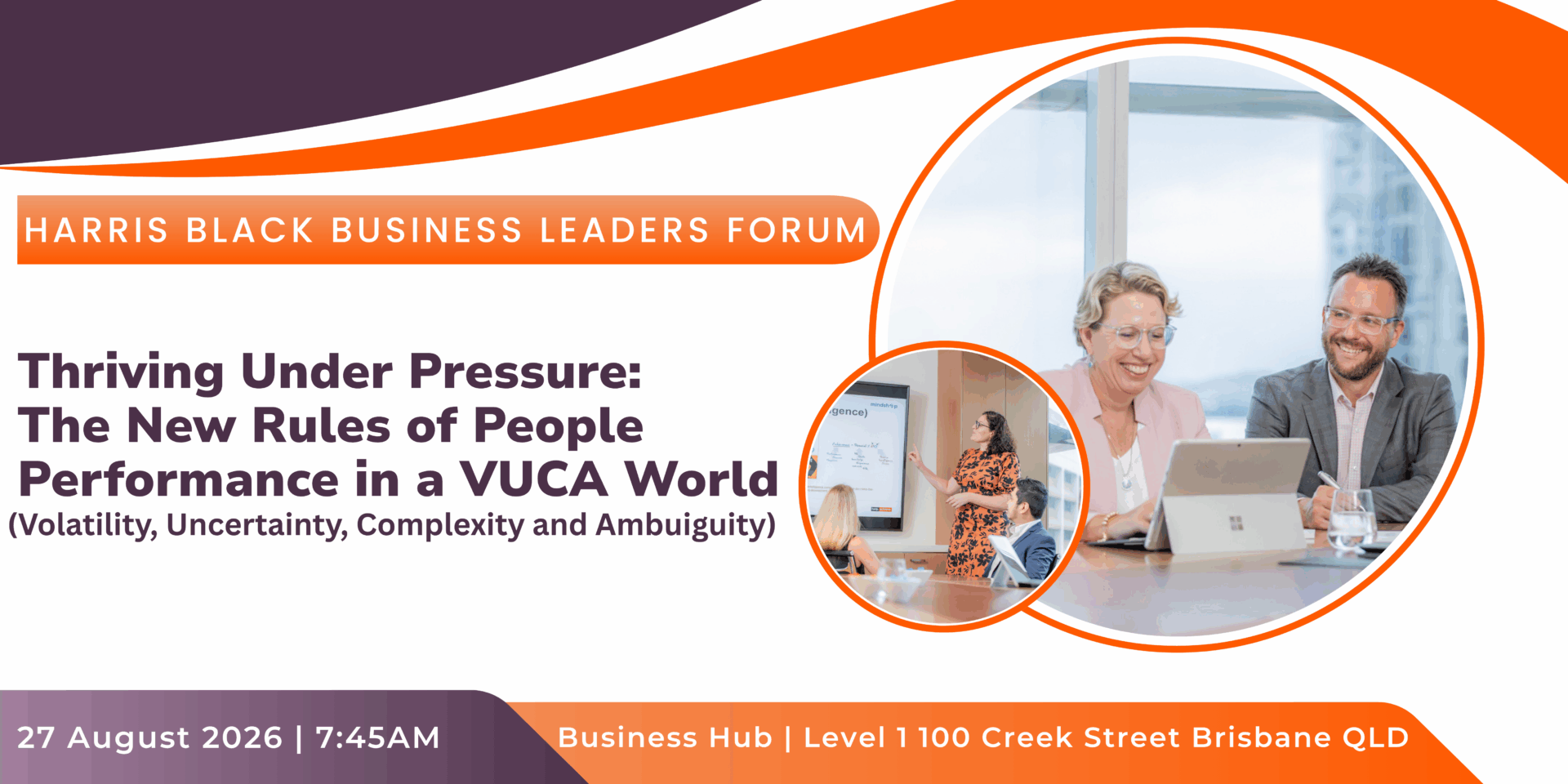
RECAP: Harris Black Business Leaders Forum – August 2026

Thriving Under Pressure: The New Rules of People Performance in a VUCA World
Date: 27 August 2026

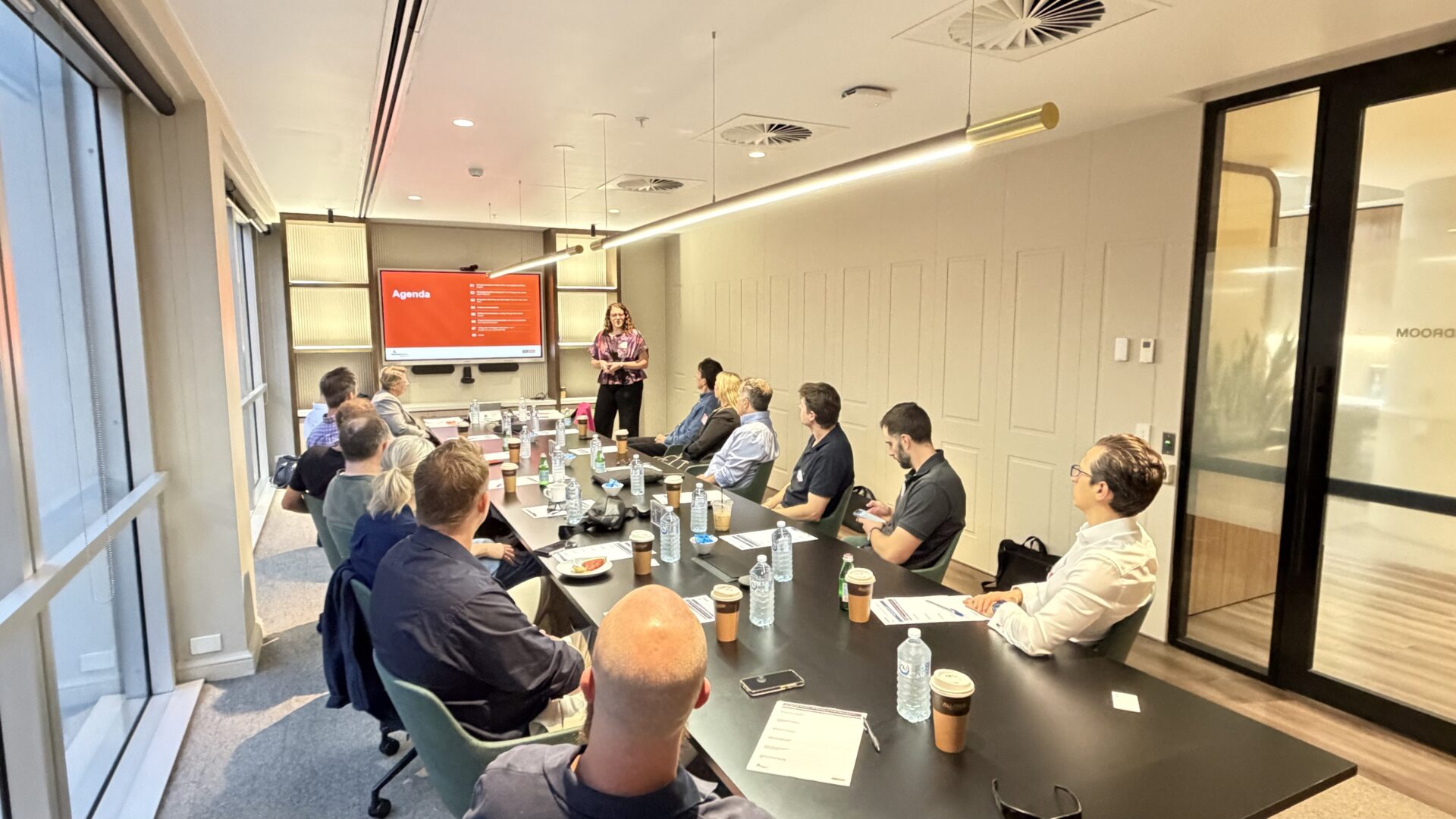
In this workshop, we looked at Thriving Under Pressure: The New Rules of People Performance in a VUCA World.

This interactive workshop gave leaders space to step back and focus on what matters most: strategy, coaching, and implementation.

Key themes explored:

  • why capacity runs out faster than it used to 
  • how to hand off the work that’s draining you 
  • new efficiency approaches 
  • best practice insights to people performance in a challenging market 
  • and how to handle the conversations most leaders avoid.  

Through peer discussion and real-world challenges, participants left with sharper thinking, experienced peer perspective, and a handful of practical shifts to lead higher performance without burning out.

Want in next time?

If you are interested in joining our practical and high-value learning workshops, we would like to invite you to join us at the next Harris Black Business Leaders Forum on 12 November 2026. Click the button below to register your interest.

Scan to save the date!

Card Payment Surcharges to End from 1 October 2026

From 1 October 2026, card payment surcharges will no longer apply, meaning customers will pay the same price regardless of whether they choose to pay by debit card, credit card, or cash.

The change aims to simplify transactions and provide greater transparency for consumers by removing unexpected fees at the checkout. Businesses will need to adjust their pricing and payment systems ahead of the transition to ensure compliance with the new requirements.

For customers, this means:

  • No additional surcharge on card payments.
  • Greater certainty about the total cost of purchases.
  • Easier comparison of prices between businesses.


For businesses, now is the time to:

  • Review pricing structures and payment processes.
  • Update point-of-sale systems and websites.
  • Remove any surcharge notices displayed in-store or online.

Heffron Super Intensive Day 2026 — “In the Trenches”

Keziah Sedgwick (Principal) and Louise Chen (Manager) recently attended Heffron’s Annual Super Intensive Day, presented by Meg Heffron, Lyn Formica, Annie Dawson and Leigh Mansell.

With the 2026-27 Federal Budget tax reforms now legislated, this year’s program was less about tinkering at the edges and more about rethinking where clients should be holding wealth at all.

Strategy update

Meg Heffron opened with modelling on how the proposed changes to trusts, capital gains tax and property investment shift the balance between superannuation and other structures. The key question for advisers: do the new settings favour holding particular assets inside super versus outside it — and does the answer change for clients affected by Division 296?

Contributions — now and next

Lyn Formica walked through the CGT changes commencing 1 July 2027: the 50% CGT discount for individuals and trusts is replaced with cost base indexation, a 30% minimum tax on capital gains is introduced, and the new rules apply prospectively to gains accruing from that date, including on pre-CGT assets. Carve-outs remain for new residential dwellings and affordable housing, and the small business turnover threshold lifts from $2m to $10m. Importantly, complying super funds keep their own separate treatment — including the one-third discount — which is precisely why contribution timing and structuring conversations need to start now, not in 2027.

Death and super

Annie Dawson revisited the “as soon as practicable” cashing requirement, confirming the widely-cited six-month rule was only ever an ATO rule of thumb from a 2015 webinar. Practical takeaway: where benefits aren’t cashed by 30 June, document the reasons for the audit file — and start collecting deed, nomination and pension commencement documents at onboarding rather than after a death.

Can I really do that?

Leigh Mansell tackled residency traps for members living overseas — central management and control, the active member test — plus release authorities paid from pension accounts.

In the trenches

The day closed with real client scenarios: late SMSF annual return lodgements and Super Fund Lookup status, section 66 related-party acquisition breaches, deferred allocation strategies, and the treatment of compensation payments received by funds.

A valuable day, and plenty for our super team to work through before 1 July 2027.

Meet The Staff – Amelie Smith

It’s time to re-meet Amelie and get to know a little more about the person behind the familiar face at Harris Black. Outside of work, Amelie has plenty to keep her busy, from collecting figurines and vinyl records to gaming, learning new things, and playing bass guitar. She’s also got a few exciting trips on the horizon, with Melbourne coming up soon and Japan planned for next year.

When it comes to food, Amelie’s ultimate comfort meal is her Mum’s cheesy potato bake, while Japanese chicken curry is her speciality in the kitchen. Her ideal dinner party would be a family affair, bringing together her Grandad, Gar-Gar, Nanna and Pa. When it comes to her dream car, Amelie is keeping things practical and fun opting for a souped-up golf cart over the usual luxury or sports car!

One of Amelie’s favourite Harris Black memories is Staff Day 2024 especially the karaoke, and she could easily fill 40 minutes talking about the Brisbane Lions. If she ever found herself stranded on a deserted island, she’d be well prepared with a first aid kit, a very comfortable sleeping bag and a knife.

With her mix of creativity and curiosity, it’s great to learn a little more about Amelie and what makes her such a valued part of the team.

How can we help you?

Today’s financial environment demands a regular review of strategy and a focus on execution.