


Australia’s capital gains tax framework changes substantially from 1 July 2027. The reforms affect how existing assets are valued, how future capital gains are calculated, how capital losses are used and which small business concessions remain available.
For many taxpayers, the first task will be identifying assets held at 30 June 2027 and understanding how the transition rules divide gains between the old discount regime and the new indexation regime.
1. Cost Base Reset and the 1 July 2027 Transition
Taxpayers holding CGT assets at 30 June 2027 are generally treated as having disposed of those assets immediately before 1 July 2027 and reacquired them immediately afterwards.
No actual sale occurs and the gain or loss from the deemed disposal is not normally taxed immediately. Instead, the pre-1 July 2027 gain or loss is deferred until the asset is ultimately realised. The actual disposal can therefore produce two components as follows:
- A deferred gain or loss attributable to the period before 1 July 2027.
- A separate post-1 July 2027 gain or loss, calculated under the new indexation rules.
The two components can receive different tax treatment. An eligible deferred gain retains the old-law treatment, including the 50% discount where the relevant requirements are satisfied. The post-transition component is calculated by indexing the reset cost base for inflation and does not generally receive the ordinary 50% discount.
Why the 30 June 2027 value matters
Under the market-value method, the asset’s value at the transition becomes both the deemed proceeds used to calculate the deferred gain or loss and the starting cost base for calculating the post-1 July 2027 gain or loss.
A valuation undertaken close to 30 June 2027 may therefore need to be relied upon many years later. Taxpayers should consider the supporting evidence for real property, listed and unlisted investments, private company shares, trust and partnership interests, goodwill, intellectual property, business assets and pre-CGT assets.
What if the asset cannot be readily valued?
Some assets, particularly private company shares, goodwill and interests in closely held structures, may not have a readily observable market value. The legislation allows taxpayers to choose between the market-value method and an amount worked out under the statutory apportioning method. The choice is made when lodging the income tax return for the year in which the asset is ultimately realised.
How the apportionment method works
The apportionment method allocates the overall economic gain between the period before 1 July 2027 and the period from that date. It provides an alternative where a transition-date valuation is unavailable, unreliable or disproportionately costly.
For example, assume an asset was purchased on 1 July 2017 for $500,000, sold on 1 July 2037 for $2.5 million and held for 20 years, divided equally between the pre-transition and post-transition periods. The total nominal gain is $2 million. A simplified time-based illustration would allocate:

The legislation provides for the apportioning methodology to be determined by legislative instrument. This simplified illustration explains the concept but should not be treated as the final statutory calculation until the applicable instrument and administrative guidance are considered.
2. The End of the General 50% CGT Discount and the Start of Indexation
For ordinary assets, the general 50% CGT discount is removed for gains accruing from 1 July 2027. Cost base indexation applies to eligible post-transition gains realised by Australian resident individuals and eligible trusts. There are two separate calculations required as follows:
- The deferred pre-1 July 2027 component remains calculated under the old rules and may retain the 50% discount.
- The post-1 July 2027 component is calculated by indexing the reset cost base for inflation.
Cost base indexation is intended to tax the real increase in value rather than the inflationary component. Eligible cost base expenditure is multiplied by an indexation factor determined by reference to the relevant CPI index numbers, subject to the following rules:
- Indexation generally applies to the first, second, fourth and fifth cost base elements.
- The third element, including certain ownership costs, is not indexed.
- Expenditure incurred at different times may require separate indexation calculations.
- Indexation does not apply to the reduced cost base when calculating a capital loss.
Certain new residential dwellings retain access to a 50% CGT discount, with eligible taxpayers able to choose the relevant concessional treatment.
3. A 30% Minimum Tax on Capital Gains
The 30% minimum tax operates as a top-up rather than as a separate flat rate of CGT. The taxpayer first calculates tax under the ordinary income tax rules. The tax attributable to the qualifying post-1 July 2027 capital gain is then compared with 30% of that gain. If the ordinary tax attributable to the gain is lower, additional tax is imposed for the shortfall. Broadly, the calculation involves four steps:
- Identify the taxpayer’s minimum-tax capital gain.
- Calculate 30% of that gain.
- Calculate the ordinary income tax attributable to it.
- Impose a top-up for any shortfall.
The rule applies only to qualifying gains accruing from 1 July 2027. It does not impose a flat 30% rate on all taxable income.
Taxpayers with income below $45,000
A taxpayer with taxable income below $45,000 may otherwise have part of a capital gain taxed at lower marginal rates. The minimum-tax mechanism can remove the benefit of those lower rates by topping up the tax attributable to the qualifying gain to 30%.
This can affect retirees with little income apart from investment gains, taxpayers selling after leaving the workforce, taxpayers taking a career break and surviving spouses with low recurring income. However, the minimum tax does not apply to recipients of specified payments and pensions. The available guidance specifically identifies income-support recipients, including Age Pension recipients, as exempt.
4. Pre-CGT Assets Enter the CGT System for Future Growth
Assets acquired before 20 September 1985 have historically been outside the CGT system in many circumstances. From 1 July 2027, future gains and losses accruing on these assets are brought within the CGT rules.
A pre-CGT asset held at the transition is generally treated as disposed of immediately before 1 July 2027 and reacquired immediately afterwards for market value or, if chosen, an amount worked out under the apportioning method as follows:
- Growth occurring up to 30 June 2027 remains protected.
- The asset ceases to retain full pre-CGT protection for future growth.
- Growth accruing from 1 July 2027 is calculated using the new indexed cost base.
5. Capital Gain Categories and Loss Utilisation
From 1 July 2027, the net capital gain calculation expands from five steps to seven steps. Capital gains and losses must be processed in four categories.
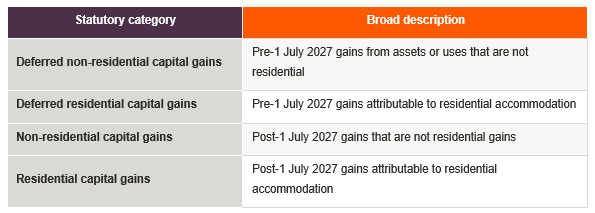
Current-year and carried-forward capital losses must be applied in that order. Taxpayers retain some choice between gains within the same category but cannot choose freely between the four categories.
Why the ordering can reduce the value of a loss:
- Applying $1 of capital loss against an undiscounted gain can save 47 cents of tax for an individual on the top marginal rate.
- Applying $1 of loss against a gain that would otherwise receive the 50% discount can save only 23.5 cents.
- The reduction in the economic value of the loss can therefore be 23.5 cents per dollar.
The calculation is: $1 x 50% x 47% = 23.5 cents.
If statutory ordering forces a $100,000 loss against a deferred discount gain when the taxpayer also has an undiscounted post-2027 gain, the loss may provide only $23,500 of tax relief instead of as much as $47,000. The potential reduction in value is $23,500.
6. Expanded Small Business CGT Concessions
The aggregated turnover threshold for the small business 50% active asset reduction increases from less than $2 million to less than $10 million. The taxpayer must still satisfy the remaining requirements for that concession.
The active asset reduction remains distinct from the general 50% CGT discount. An eligible taxpayer may apply the small business 50% active asset reduction after applying the relevant CGT calculation rules, including the post-2027 indexation provisions.
Other Small Business CGT Concessions
The eligibility requirements for the other small business CGT concessions remain unchanged. The increase to $10 million does not automatically provide access to:
- 15-year exemption: an eligible gain may be disregarded where the ownership, age, retirement, permanent incapacity and other requirements are satisfied.
- Retirement exemption: eligible gains may be disregarded up to the applicable lifetime limit, subject to payment and contribution requirements.
- Small business rollover: an eligible gain may be deferred, subject to replacement-asset and other rollover requirements.
A taxpayer with aggregated turnover of $2 million or more will not qualify for these other concessions merely because turnover is below the new $10 million active asset reduction threshold. Access generally still requires an alternative gateway, such as the $6 million maximum net asset value test, together with the remaining concession-specific conditions.
Where the relevant CGT asset is held by an entity other than the entity conducting the business, the additional object-entity, ownership or participation requirements must also be considered. If the applicable net asset or object-entity tests are not passed, the other concessions will not become available solely because the $10 million threshold applies to the active asset reduction.
Important information
| General information only This article is a general summary and the calculations are simplified. Tax outcomes depend on the taxpayer’s circumstances, the final legislative instruments, actual CPI data, asset-specific cost base elements, concessions, exemptions, losses and residency status. Professional advice should be obtained before implementing a transaction. |
Illustrative Comparison of Old and New Outcomes
These calculations are simplified illustrations rather than forecasts of actual CPI movements.
General assumptions
| Five-year holding period after 1 July 2027. | Inflation of 3% compounded annually. |
| Illustrative indexation factor: 1.03⁵ = 1.1593. | Top marginal tax rate of 47%, including Medicare levy. |
| Eligible deferred gains receive the 50% discount. | Indexation applies only to the post-1 July 2027 cost base. |
| ‘Old rules’ assumes the former regime had continued. | Retiree and widow examples not the top marginal rate. |
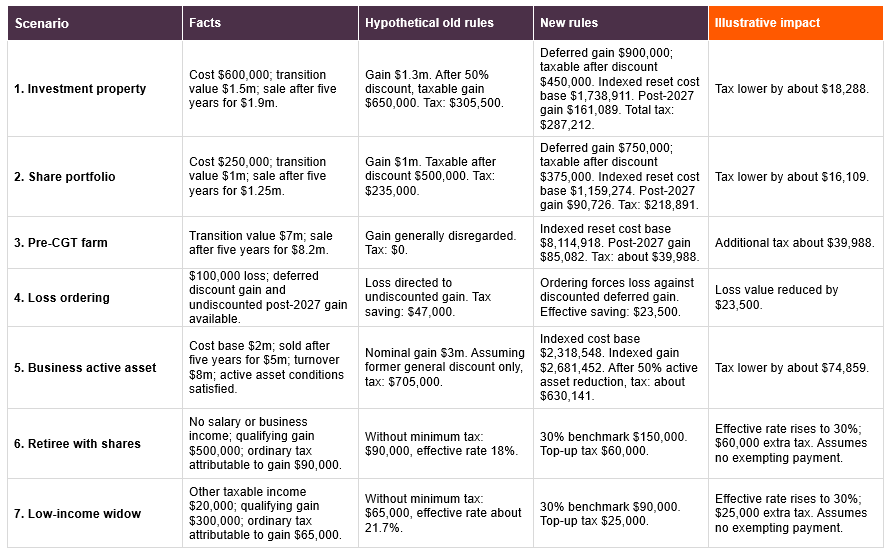
The five-year indexation examples show that the new system will not automatically produce more tax in every case. Outcomes depend on the timing and size of the pre-transition gain, actual CPI movements, the period for which indexation is available, the relevant cost base elements, and whether the minimum tax or another concession applies.